November 21, 2026
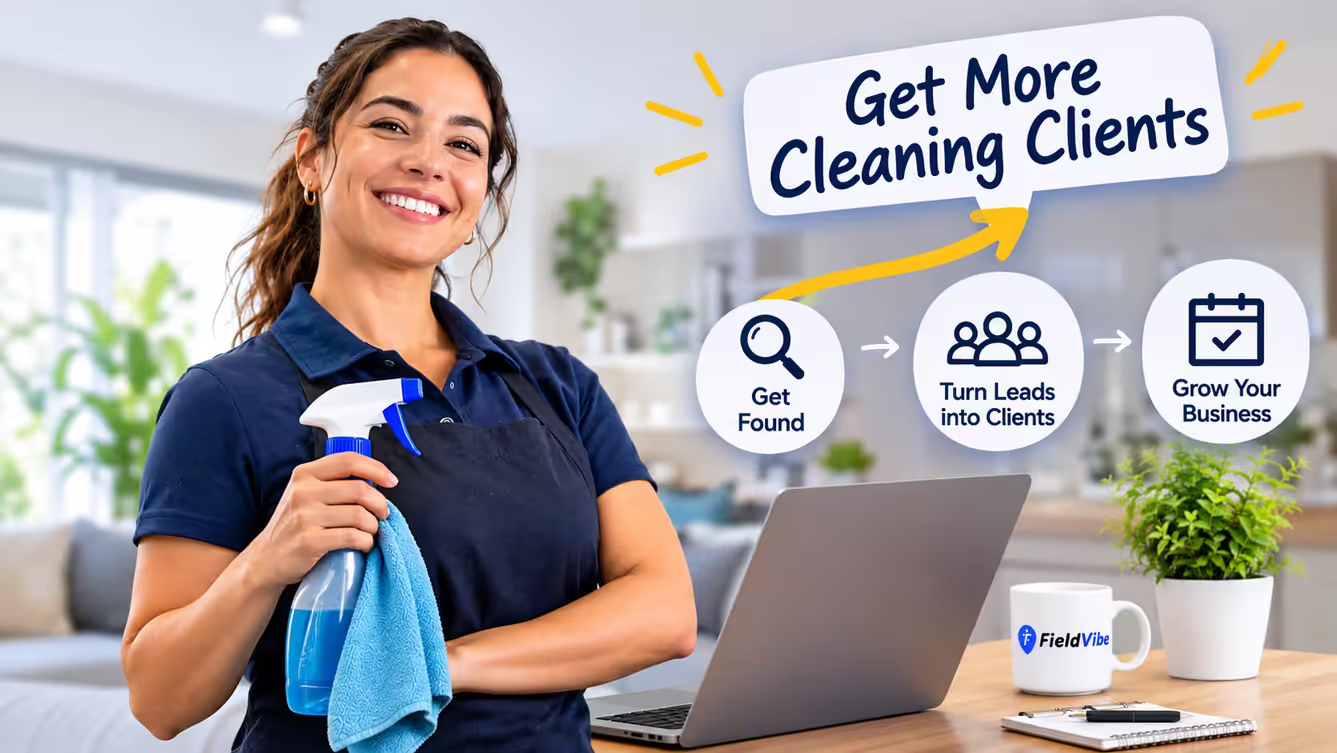
How to Get Clients for a Cleaning Business (Even If You're Just Starting)
By Adrian Cucerzan · Last updated November 21, 2026
You've got the supplies and you know which services you want to offer. What you need now is customers.
Getting the first few can be harder than expected. You post in a local Facebook group and hear nothing. You hand out flyers and the phone stays quiet. Someone asks for a quote, then disappears after hearing the price.
The short answer: start with people and neighborhoods close to you, reply to people who are already looking for a cleaner, set up a Google Business Profile, and ask every happy customer for an honest review and a referral. Then offer a recurring slot after the first clean, and keep track of which methods bring paying customers, not just likes or messages.
This guide shows you how to do each of those, with copy-paste messages you can use today and a simple plan for your first 30 days.
Disclosure: This guide is published by FieldVibe, field service software for solo pros and small teams. We mention where FieldVibe can help, but the advice works whether you use it or not.
Quick answer: 10 ways to get cleaning clients
- Ask people you know for introductions. Ask each person to introduce you to one specific homeowner, landlord, or business that might need cleaning.
- Reply to local requests for cleaner recommendations. Search neighborhood Facebook groups and Nextdoor for people already looking for a cleaner.
- Set up a Google Business Profile. Add your service area, contact details, services, photos, and a link where people can request a quote.
- Ask happy customers for honest reviews. Make it easy for people who actually hired you to share their experience.
- Pick one neighborhood and market there consistently. Use door hangers (where allowed), local groups, and referrals instead of spreading yourself across a whole city.
- Contact realtors and property managers. Offer move-in, move-out, and pre-listing cleans.
- Approach small offices and local businesses. Find out who handles cleaning and offer a walkthrough.
- Reach out to short-term rental hosts. Explain how you handle turnovers, timing, checklists, and updates when you're done.
- Post real before-and-after photos. Show your work, with the client's permission and nothing private in the shot.
- Follow up and offer recurring appointments. A first clean can become a weekly or every-two-weeks customer.
You don't need all ten at once. Start with two or three, track the inquiries and bookings they bring, and put more time into the ones that work in your area.
Before you look for clients: get four things ready
Marketing is wasted if interested people can't understand what you offer, trust you, or take the next step. Sort these out before you spend money on advertising.
1. Decide which customers you want to serve
"I clean anything" is hard to remember. A specific offer helps the right people recognize you're a fit. Pick one main service to lead with:
- Recurring house cleaning: weekly, every two weeks, or monthly.
- Deep cleaning: a detailed one-time clean, often before a recurring schedule starts.
- Move-in and move-out cleaning: for renters, landlords, property managers, and people moving home.
- Short-term rental turnovers: cleaning between guest stays, often on a tight deadline.
- Small commercial cleaning: offices, studios, shops, and other small workplaces.
You can offer more than one. But make your first marketing message specific: "Every-two-weeks house cleaning in Oak Ridge" is easier to understand than "all cleaning services available."
Also decide where you'll work. A tight service area means less driving and makes it easier to fit jobs together.
Still setting up the business itself? Read how to start a cleaning business.
2. Know how you'll price a job before someone asks
People ask "how much?" first. You don't need a complicated price list, but you should know what information you need before giving a quote, and you should price the first clean separately from recurring visits. The pricing section below explains how.
3. Make it easy to request a quote
Someone might find you at 10 p.m. or between errands. Give them a way to reach you that doesn't depend on you picking up the phone. At minimum, have:
- Your business name and service area
- A phone number or business email
- A clear list of services
- A few real photos of your work (with permission)
- A simple way to request a quote
A basic website or request page gives you one link to share in local groups, on flyers, and on your Google Business Profile.
Where FieldVibe helps: FieldVibe's free Solo plan includes a business website with a work request form, at a link like book.fieldvibe.com/your-business-name. Potential customers send their contact details, address, and what they need, and the request arrives in the app so you can reply between jobs. Customers send a request; they can't pick and book a time slot themselves.
4. Give people reasons to trust you
A new cleaning business doesn't have years of reviews. You can still make it easier for someone to feel comfortable contacting you:
- Complete your Google Business Profile.
- Say exactly what's included in each service.
- Use real photos of your work, with permission.
- Say whether you bring your own supplies and equipment.
- Be clear about your service area and availability.
- If you're insured or have background checks, say so accurately. Never claim coverage or credentials you don't have.
- Send a written quote that explains the work, the price, and anything not included.
You're asking to come into someone's home or workplace. Trust is part of what they're buying.
How to get your first five cleaning clients
Your first customers usually come from people who already know you, local recommendations, or someone searching nearby. The goal isn't to look like a big company. It's to make a clear, trustworthy offer and do the first few jobs really well.
Ask friends, family, former coworkers, and neighbors for introductions
Tell people you've started a cleaning business. Don't stop at "please spread the word." Ask each person whether they can introduce you to one person who might need a cleaner.
Template: introduction ask
I've started offering house cleaning in [area]. Do you know one person who's been looking for a reliable cleaner? If you introduce us, I'll send them my service details and a quote.
Give them a short message they can forward, so they don't have to write one:
Template: message a friend can forward
Someone I know has started a local cleaning service in [area]. They offer [main service]. If you're looking for a cleaner, here's their page: [link].
If you clean for a friend or family member, treat it like a real job: agree on what's included, do the work, and ask for honest feedback. They should leave a review only if they actually used your service, and the review should reflect their real experience.
Reply to people already asking for a cleaner
This works better than posting an ad and hoping someone sees it. Search local Facebook groups and Nextdoor for phrases like:
- "Looking for a house cleaner"
- "Can anyone recommend a cleaner?"
- "Need a move-out clean"
- "Looking for biweekly cleaning"
- "Cleaning service in [neighborhood]"
Turn on notifications for new posts in the most active groups. When you find a request, reply quickly and politely with the service you offer, the area you cover, and how to request a quote. Follow each group's rules, and don't message people who haven't invited it.
Template: reply to a recommendation request
Hi [Name], I provide [weekly / every-two-weeks / deep] house cleaning in [area]. If you're still looking, I'd be happy to learn a little about the home and send you a quote. Here's my page where you can send a request: [link]. Thanks!
Post an introduction in local groups (where allowed)
If a group allows business posts (many only allow them on certain days), post a short, personal introduction. People hire a person, not a logo.
Template: Facebook or Nextdoor post
Hi neighbors! I'm [Name], and I run [Business Name], a local cleaning service in [Area]. I offer [weekly and every-two-weeks house cleaning / deep cleans / move-out cleans]. I bring [my own supplies — only if true] and currently have openings on [days]. If you're looking for help, you can request a quote here: [link] or send me a message. Thanks for supporting a local business!
Add one or two real photos if you have permission. Don't judge the post by likes; count how many people ask for details, request a quote, and book.
What other cleaning business owners say
Cleaning business owners discuss these questions openly on Reddit. These threads are worth reading for the practical questions new owners face, not just polished marketing advice:
- How did you actually get your first clients for a cleaning business? (r/cleaningbusiness): owners share where their first customers came from.
- Just started our cleaning business. Looking for advice on getting more clients! (r/cleaningbusiness): new owners ask how to find customers when they're just starting out.
- What's the method you use for pricing a new client? (r/cleaningbusiness): cleaners compare how they price a first visit for a new client.
- Struggling to get clients for new cleaning business (r/sweatystartup): a new owner asks for help when early marketing isn't working.
These are personal experiences and opinions. Use them to learn which questions to ask and which approaches to test, not as proof that a tactic will work in every area.
Where to find more cleaning clients
Once you've told your network and started replying to local requests, build a few steady sources of inquiries.
Set up your Google Business Profile
When someone searches for a cleaner nearby, a Google Business Profile can help you show up in local results and on Google Maps. It's free. It won't guarantee a top spot or a steady flow of leads, but it's the foundation for a local cleaning business.
- Choose the most accurate primary category (for example, "House cleaning service").
- Set the towns or ZIP codes you serve. If you work from home and don't serve customers there, follow Google's service-area business guidance and hide your address.
- Add your phone number, hours, services, and your website or request link.
- Add real photos of your work and equipment.
- Keep your information accurate and update it when anything changes.
- Ask real customers for honest reviews, and reply to every review professionally.
Don't buy reviews, write fake ones, or ask friends and family to review you if they haven't used your service. A few honest reviews beat a pile of fake ones, and fake reviews can get removed.
Have a simple website
You don't need an expensive website. You need a page that answers what a customer wants to know:
- What do you clean?
- Which neighborhoods or towns do you cover?
- Do you do recurring, deep, move-in, or move-out cleaning?
- What's included?
- How can someone request a quote?
- What shows you're reliable (photos, reviews)?
Use the same business name, phone number, and service area on your website and every profile. Write about the areas and services you actually cover. Don't create dozens of near-identical pages that only swap city names.
Where FieldVibe helps: FieldVibe's free business website lets you add your business info, services, photos, a work request form, and your best client reviews. It's built so Google can index it, but no website ranks you automatically: your Google profile, reviews, location, and local competition all matter. See how FieldVibe works for cleaning businesses.
Test flyers and door hangers in one neighborhood
Flyers can work, but test before you print hundreds. Pick one neighborhood in your service area where you'd like several clients close together, hand out a small batch, and track:
- How many you handed out
- How many calls, texts, or quote requests came from them
- How many of those became paying customers
- What you spent on printing
Put on the flyer:
- The service you offer and the neighborhood you cover ("Weekly house cleaning in Maple Heights")
- One reason to contact you now, such as openings for new recurring clients
- Your phone number and a short link to request a quote
- A QR code that goes straight to your request page (use a unique link or QR code for each campaign, so you can tell what worked)
Check local rules first. In the US, don't put flyers or door hangers in or on mailboxes; USPS rules reserve mailboxes for U.S. Mail.
Contact realtors, landlords, and property managers
People moving in or out often need cleaning on a deadline. Realtors, landlords, leasing offices, and property managers may need a reliable cleaner for move-in and move-out cleans, cleaning before listing photos or showings, cleaning between tenants, and occasional deep cleans.
Don't send a vague "I do cleaning." Say which job you help with, where you work, and how fast you can usually come.
Template: realtor or property manager outreach
Hi [Name], I'm [Name] from [Business Name], a cleaning service in [Area]. I help with move-out, move-in, and pre-listing cleans. If you ever need another reliable cleaner for a property, I'd be happy to send my service details or arrange a walkthrough. Here's my contact and request page: [link]. Thanks for your time.
Follow up politely if you don't hear back. A property manager may already have a cleaner and only need a backup when that cleaner is busy. Do one job really well: one good realtor or property manager can send you work again and again.
Reach out to short-term rental hosts
Turnovers can bring frequent repeat work, but they aren't just ordinary cleans done more often. The property has to be ready between checkout and the next guest's arrival. Before you accept, agree on:
- Checkout and check-in times
- The cleaning checklist
- Who handles linens and laundry
- What to restock
- How to report damage or missing items
- Whether you can handle same-day changes
- What happens if you're sick or unavailable
Find hosts through local host groups and property managers. Be honest about how many properties and how tight a turnaround you can handle.
Post real before-and-after photos
Cleaning is one of the few services where the result is easy to show. A greasy oven next to a spotless one says more than any ad.
- Always ask the client before taking or posting photos.
- Never show anything personal: faces, mail, family photos, house numbers.
- Post on Facebook, Instagram, and your Google Business Profile with a short caption: what you did, the area, and how to request a quote.
Where FieldVibe helps: On FieldVibe's paid plans (Solo Pro and Crews), you can turn your before-and-after photos into ready-to-share social posts from the app.
A note on paid lead sites
Paid lead platforms can send you potential customers, but a lead isn't a booking. Before you pay, check the current fees, whether the same lead goes to other cleaners too, and what happens if a lead is fake or never replies. Track what you spend and how many paying customers you win before you increase your budget. Over time, aim to get most clients from referrals, Google, and your own website, which don't charge you per lead.
How to get commercial cleaning clients
Small offices, studios, shops, and gyms can be steady weekday or after-hours work. Commercial cleaning usually needs a more detailed quote and a conversation with whoever is responsible for the building.
Start with places that fit your current capacity:
- Small professional offices
- Retail shops and studios
- Gyms and other local facilities
- Property managers with smaller buildings
Find out who handles cleaning or facilities, and ask for a walkthrough before giving a firm price. Check the areas to clean, how often, access and security (keys, alarms), and whether the work must happen outside business hours.
Template: opening for a small office
Hi, I'm [Name] with [Business Name]. We clean small offices in [Area]. Who would be the right person to talk to about your cleaning? I'd be happy to leave a one-page summary or arrange a walkthrough if you're reviewing cleaning providers.
Your written quote should spell out:
- Which rooms and surfaces are included
- How often you'll clean, and on which days and times
- Which supplies and equipment are included
- Anything excluded or charged extra
- How you'll handle access, keys, alarms, and missed visits
Commercial clients may not switch cleaners right away. Keep a simple follow-up list and check back respectfully. If you're new to commercial work, start with one account you can handle well before taking on several.
Where FieldVibe helps: On Solo Pro ($20/month), you can send professional quotes from your phone and turn approved quotes into scheduled, recurring jobs. See how quoting works.
How to turn inquiries into booked cleans
A message isn't a booking. People often contact several cleaners, so make your offer easy to understand and the next step easy to take.
Reply quickly and ask the right questions
Don't guess a price from one detail. For a home, ask about:
- Approximate size, bedrooms, and bathrooms
- The type of clean they want
- The home's current condition and when it was last professionally cleaned
- Pets, special surfaces, or other requirements
- Their preferred date, and whether they want recurring service
If you need a walkthrough, explain why. If photos or a short video are enough for a first estimate, tell them what to send.
Send a clear quote, not just a number
A useful quote tells the customer what they're paying for:
- The service and the areas covered
- What's included and what isn't (for example, say whether inside the oven is included or an add-on)
- The price and what it's based on
- The arrival window or expected time, if known
- The proposed date and the next step
- How extra work will be approved and charged
If the home turns out different from what the customer described, talk to them before doing extra work or changing the price.
Follow up when someone doesn't book
Some people need time to compare quotes or check their calendar. One polite follow-up brings the conversation back without pressure.
Template: quote follow-up
Hi [Name], just checking whether you had a chance to look over the cleaning quote I sent. I'm happy to answer any questions or adjust the date if needed. If you'd like to go ahead, let me know and I'll confirm the next step. Thanks, [Name]
If they don't reply after that, move on.
Track where your customers come from
Keep a simple record of every inquiry:
| What to track | Why it matters |
|---|---|
| Lead source | Shows which channels bring inquiries |
| Date received | Helps you spot slow replies |
| Service requested | Shows which offers people want |
| Quote amount | Helps compare the value of inquiries |
| Booked or not | Shows which leads become customers |
| Reason lost, if known | Points to price, timing, or trust problems |
| Repeat booking | Shows which customers are worth the most over time |
After a few weeks, you'll know whether Facebook groups, referrals, Google, flyers, or direct outreach deserve more of your time.
How to price your first cleaning jobs without losing money
Winning a customer isn't a win if the job costs you more time and money than you expected.
A common mistake is copying another cleaner's prices, or quoting low just to get the booking. You don't know that business's costs, speed, travel time, or what their price includes.
Before you quote:
- List the rooms and tasks included.
- Estimate the time for each area.
- Add setup, travel, supplies, and access time.
- Note anything that could add a lot of time: pets, clutter, heavy kitchen grease, hard-water buildup.
- Say clearly what's outside the agreed scope.
Two homes with the same square footage can take very different amounts of time.
Price the first clean separately from recurring visits. The first visit usually takes longer because you're bringing the home up to the standard you'll maintain afterward.
Example: A customer asks for every-two-weeks cleaning, but the home hasn't been professionally cleaned in months. Don't charge the regular rate for the first visit. Explain that the first clean takes more time, quote it separately, then agree on the recurring price once the home is at the maintenance standard.
Agree in advance on how extra work is handled. If a customer asks you to clean inside the oven and it wasn't in the quote, explain the extra charge and get approval first.
After each job, write down how long it actually took. Your own records will make your next quotes far more accurate than a competitor's price list.
The goal isn't to be the cheapest cleaner in town. It's a fair price for clearly defined work, enough to keep delivering a reliable service.
How to turn first cleans into recurring clients, reviews, and referrals
A one-time deep clean is a good first job. Recurring customers make your week easier to plan and your income more predictable.
Offer the next visit before you leave
After the first clean, offer to keep the home at the same standard on a regular schedule:
"Now that the home is back in shape, regular cleaning will take less time. I have a Thursday morning opening every two weeks. Would you like me to hold that for you?"
Explain the options and let the customer decide.
Ask for a review the same day
Ask while the clean is fresh in their mind. If they're happy, send a link where they can leave an honest review.
Template: review request
Hi [Client name], thanks for having me today! If you're happy with the cleaning, would you mind leaving an honest review? It helps people nearby feel confident choosing a local cleaner. Here's the link: [review link]. Thank you!
Never offer a reward in exchange for a positive review, and follow each review platform's rules.
Where FieldVibe helps: FieldVibe lets you collect reviews from clients after a job and share your best ones on social media. It's included in the free plan.
Ask for a referral
Most happy clients will recommend you; they just don't think to unless you ask.
Template: referral request
Hi [Client name], thanks again for having me today. I'm growing my cleaning business through local recommendations. If you know a friend or neighbor who needs cleaning, I'd really appreciate you passing along my details: [link]. Thank you!
If you offer a thank-you for referrals, such as a discount on the next clean, keep it simple and the same for everyone.
Why cleaning clients cancel (and how to keep them)
Every client who leaves has to be replaced, so keeping clients is just as important as finding them. Clients often leave when the service feels unreliable or inconsistent: missed appointments, late arrivals with no warning, missed tasks, or a different cleaner every time. Here's how to prevent each one.
Confirm every visit the day before
A reminder lets the customer confirm, ask a question, or reschedule before you make the trip, instead of you arriving at a locked door.
Template: day-before reminder
Hi [Client name], this is [Name] from [Business Name]. Just a reminder that I'll be there tomorrow, [day], between [time window]. Please let me know if anything has changed. See you then!
Where FieldVibe helps: On the free plan, you send reminders with one tap from your own phone number. On Solo Pro ($20/month), reminders go out automatically: up to 400 a month in the US and Canada.
Tell them early if you're running late
Text before the arrival window has passed, not after. A short, honest update beats leaving someone wondering where you are.
Send the same cleaner when you can
Customers are letting someone into their home. If you grow into a team, keep the same cleaner on the same customers whenever the schedule allows.
Use client notes and a checklist
One customer cares most about the kitchen. Another has instructions about pets, products, or rooms to skip. Write those down so the customer never has to repeat them, and use a checklist so nothing gets missed from visit to visit.
Follow up after the clean
A short message gives customers an easy way to raise a small issue before it becomes a reason to cancel.
Template: after-clean follow-up
Hi [Client name], I finished at your place today. Is there anything you'd like me to do differently next time? I want to make sure everything's just the way you like it. Thanks!
Your first 30 days: a practical plan
| Week | What to do |
|---|---|
| Week 1: Get ready | Choose your main service and service area. Work out how you'll price. Set up your request page and Google Business Profile. Tell friends, family, and former coworkers, and ask for specific introductions. |
| Week 2: Find local demand | Search local Facebook groups and Nextdoor for people asking for cleaners. Post one clear introduction where allowed. Contact five realtors or property managers. Test a small batch of flyers in one neighborhood. |
| Week 3: Convert and deliver | Reply quickly to inquiries. Ask the right questions, send clear quotes, and follow up once. Do the booked jobs well, write down the actual time, and ask happy customers for honest reviews. |
| Week 4: Build repeat business | Offer recurring appointments. Contact a few local businesses or rental hosts. Look at which channels brought inquiries and bookings, and focus on those. |
At the end of the month, check your numbers:
- How many inquiries did you get, and where did they come from?
- How many quotes did you send?
- How many customers booked?
- How many booked a second visit?
- Which jobs were profitable after time, travel, and supplies?
Keep doing what brings good customers. Change or drop what takes time without bringing inquiries.
Where FieldVibe fits
Once customers start coming in, keeping track of their details, appointments, and follow-ups matters as much as finding them. FieldVibe is field service software for solo pros and small teams, including cleaning businesses:
- A free business website with a work request form, so new customers can reach you any time.
- Client profiles and job history, with notes like entry codes and preferred products, plus visit photos.
- Recurring jobs for weekly, every-two-weeks, or monthly cleans.
- Reminders so clients don't forget: tap-to-send from your own number on the free plan, automated on Solo Pro.
- Review collection, so you can ask for feedback after a job and share your best reviews.
- Quotes, invoices, and payments from your phone on Solo Pro ($20/month).
The Solo plan is free for one person, with unlimited jobs and clients. It's a free plan, not a trial. No sales calls and no mandatory demo: you can set it up yourself in a few minutes.
See FieldVibe for cleaning businesses or start with the free plan.
FAQ: Getting clients for a cleaning business
How do I get my first cleaning clients?
Start with people who already know you and ask for specific introductions. Then reply to local Facebook and Nextdoor posts from people looking for a cleaner, set up your Google Business Profile, and contact nearby realtors or property managers. Make it easy for interested people to request a quote.
How can I get cleaning clients fast?
Go to people who are already looking for a cleaner: local recommendation requests, referrals, property managers with a move-out job, or rental hosts who need a turnover. Reply quickly and have a clear service offer and quote process ready. Results depend on your area, availability, and competition.
How can I get cleaning clients for free?
Ask for referrals, reply to local recommendation requests, create a free Google Business Profile, and share real photos of your work. These methods cost time, not money per lead. A simple website or request page gives people one link to contact you.
How do I get cleaning clients with no experience or reviews?
Start with a clear service offer and a small area you can serve reliably. Say exactly what's included, show real photos of your work when you have permission, and be honest about your experience. After completing real jobs, ask happy customers for honest reviews. Never invent reviews or claim credentials you don't have.
Should I pay for cleaning leads?
Paid lead platforms can help you find potential customers, but a lead isn't a booking. Check the current fees, whether leads are shared with other cleaners, and what happens when a lead is fake or doesn't reply. Track what you spend and how many paying customers you win before increasing your budget.
How do I price my first cleaning jobs?
Estimate the time and work involved instead of copying another cleaner's price. Ask about the home's size, condition, bathrooms, pets, special tasks, and access. Consider a walkthrough or photos for first-time and deep cleans. Quote the first clean separately from recurring visits, and say what is and isn't included.
How do I get recurring cleaning clients?
After a good first clean, offer a specific weekly, every-two-weeks, or monthly time slot and explain that regular visits keep the home at the same standard. Make sure the recurring price reflects the smaller maintenance scope. Consistent work, clear communication, and reliable scheduling give customers a reason to stay.
How do I get commercial cleaning clients?
Start with small offices, shops, studios, and property managers in your service area. Find the person responsible for cleaning and ask for a walkthrough. Send a written quote that explains the scope, frequency, access arrangements, schedule, and price.
Why do cleaning clients cancel, and how do I stop it?
Clients often leave when the service feels unreliable or inconsistent. Confirm visits the day before, tell clients early if you're running late, keep the same cleaner when you can, use notes and a checklist for each home, and follow up after the clean so small problems get fixed before they become reasons to leave.