November 6, 2026
How to Start a Cleaning Business: A Step-by-Step Guide (2026)
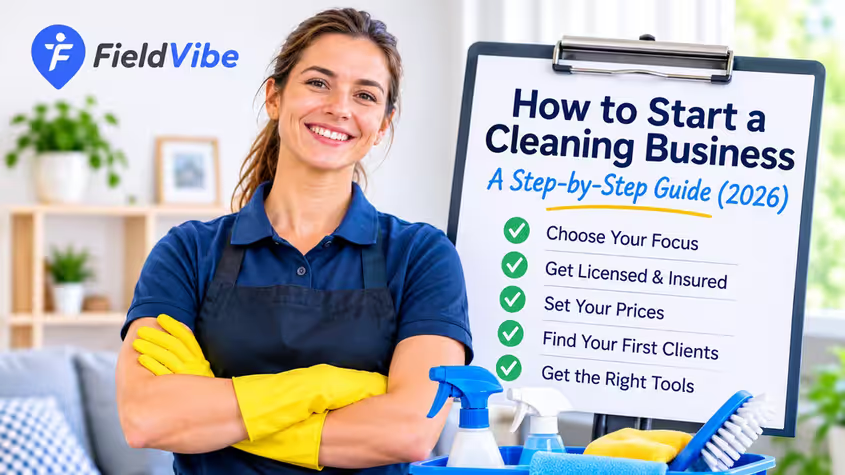
How to start a cleaning business
To start a cleaning business, pick residential or commercial work, register the business, get insured, buy a basic kit of supplies, set your prices and land your first few clients through neighbors, referrals and a free Google Business Profile. You don't need an office, a van fleet or employees to start: many cleaners begin solo, working from home and driving their own car.
The six steps below walk through each part in the order you'll do it.
Step 1: Choose residential or commercial cleaning
Start with residential cleaning if you're working solo and want clients fast; choose commercial if you'd rather work evenings on repeat contracts. Residential is usually the easier solo start, because one house is a job one person can finish in a few hours.
Then pick a short list of services. Three is plenty to start:
- Standard cleaning: kitchens, bathrooms, dusting, floors. This is the visit that repeats.
- Deep cleaning: inside appliances, baseboards, built-up grime. Often a first visit before regular service.
- Move-in and move-out cleaning: empty homes, one-time jobs, common with renters and landlords.
Add-ons like inside-the-oven, inside-the-fridge or interior windows can come later, priced per item. Pick services you can do well alone with your starter kit.
| Residential | Commercial | |
|---|---|---|
| Clients | Homeowners and renters | Offices, shops, clinics, property managers |
| When you work | Daytime, weekdays | Often evenings or weekends |
| How work repeats | Weekly, every two weeks or monthly visits | Contracts, several visits a week |
| How you win work | Word of mouth, reviews, local search | Walk-throughs, written bids |
Step 2: Register the business, get licensed and insured
Register your business with your state, get a free EIN from the IRS, check your state, county and city for a business license, and buy general liability insurance before your first job. The rules differ by state and city, so check official sources for your address instead of relying on a national checklist.
- Pick a business structure and name. Many solo cleaners start as a sole proprietor; others form an LLC to keep business and personal money separate. If you use a name other than your own, you'll usually register it as a "doing business as" (DBA) name. The SBA's Launch your business guide walks through structure, name and registration.
- Get an EIN. An EIN is your business's federal tax ID. The IRS issues one online, for free, often in minutes. Never pay a third-party site for it. If you form an LLC, form it with your state first.
- Check licenses and permits. What a cleaner needs depends on where you work: in some places it's just a general business license, in others more. The SBA's licenses and permits page says requirements depend on your activities and location and points you to your Secretary of State's website. Then check your city or county clerk.
- Get insured. General liability covers you if you break something in a client's home or someone gets hurt because of your work. The SBA's insurance guide notes that some coverage may be legally required and that laws vary by state. Before you hire, check your state's workers' compensation rules. Some cleaners also add a janitorial bond, which covers clients if an employee steals; some clients and commercial contracts ask for one.
- Open a business bank account. Keeping job income separate makes taxes and pricing much easier.
Outside the US, the same steps apply but the agencies differ. Check your national and local government sites.
Step 3: Get supplies and equipment
A solid residential starter kit centers on a reliable vacuum, an ergonomic mop system, color-coded microfiber cloths, and a core set of battle-tested cleaning products. Based on recommendations across Reddit communities like r/CleaningTips and r/housekeeping, buy high-efficiency tools designed for daily commercial use rather than gimmicky consumer gadgets, expanding your kit only when specific client jobs require it.
Equipment
- Vacuum with attachments: Choose an upright like the Shark Navigator Lift-Away for flexible residential work (highlighted in Reddit discussions on housekeeping must-haves), or a commercial backpack model like the ProTeam Super Coach 6QT to clean hard floors faster (discussed in commercial backpack vacuum recommendations). For premium HEPA filtration, canister models like the Miele C3 are widely recommended by pros.
- Flat microfiber mop system or spin mop: An 18-inch commercial flat microfiber mop with multiple replaceable pads is the industry standard for fast, streak-free floor care. For residential spin mopping, the O-Cedar EasyWring system allows precise moisture control on hardwood floors.
- Step stool: A heavy-duty 2-step folding aluminum stool (such as Cosco or Gorilla) with non-slip feet. Note: Most business insurance policies limit solo cleaners to two steps off the ground.
- Cleaning caddy and trunk storage: A heavy-duty Rubbermaid Commercial Caddy for carrying core supplies from room to room, paired with collapsible plastic totes and mesh laundry bags to keep clean and dirty microfibers separated in your vehicle.
Tools
- Microfiber cloths (color-coded): Stock up on commercial-grade microfiber towels (such as bulk packs recommended in Reddit cleaning product debates) and assign strict colors to prevent cross-contamination: Yellow for dusting, Green for kitchens, Blue for glass, and Pink/Red strictly for bathrooms.
- Scrub & detail brushes: An OXO Good Grips detail brush set, blue non-scratch scrubbing pads, and cordless Drillbrush power scrubber attachments to clean tub tile and shower grout without physical fatigue.
- Squeegee for glass & showers: A professional 10-inch or 12-inch brass/stainless squeegee (Ettore or Unger) with replaceable rubber blades for quick streak-free shower glass.
- Extendable duster: A 12-to-24 ft telescoping extension pole equipped with washable microfiber duster heads for high ceiling fans, cobwebs, and light fixtures.
- Spray bottles (labeled): Heavy-duty 32 oz Zep Commercial or Tolco chemical-resistant spray bottles clearly labeled with product names and safety info.
Products
- All-purpose cleaner: Concentrated Dawn Dish Soap mixed with warm water in a spray bottle—a surface-safe, low-cost multi-surface cleaner frequently praised in Reddit housekeeper product lists—or neutral pH concentrates like Simple Green or Odoban.
- Glass cleaner: Sprayway Foaming Glass Cleaner, an alcohol-based foam that clings to vertical glass without running or streaking, or a 50/50 mixture of 70% Isopropyl Alcohol and water.
- Bathroom cleaner & disinfectant: Bar Keepers Friend (BKF) oxalic-acid powder or soft cleanser, widely considered a holy-grail product on r/CleaningTips for removing soap scum, hard water spots, and rust on porcelain; paired with an EPA-registered disinfectant spray.
- Degreaser for kitchens: Dawn Powerwash Spray for rapid breakdown of stovetop oil and microwave grime, or heavy-duty citrus degreasers for heavy kitchen buildup.
- Floor cleaner safe for wood and tile: Neutral-pH floor cleaners like Bona Hardwood Floor Cleaner, Method Squirt & Mop, or hot water with a single drop of Dawn dish soap. Avoid heavy oil soaps or floor waxes that leave sticky residue build-up over time.
Protection and admin
- Gloves & shoe covers: Heavy-duty, tear-resistant 5-to-7 mil Nitrile gloves (latex-free) and reusable non-slip shoe booties for client homes.
- Trash bags: Heavy-duty 13-gallon kitchen tall bags and 33-gallon commercial contractor bags.
- Phone & business apps: A smartphone equipped with scheduling software (like FieldVibe), a mobile payment reader (Square), and notes detailing each client's home preferences.
Always read product safety labels, never mix bleach with ammonia or acids, and confirm any client allergies, surface sensitivities, or pet preferences prior to your initial walkthrough.
Step 4: Set your prices
Price by the hour while you learn how long jobs take, then switch regular clients to a flat rate per visit. Use square-foot pricing mainly for commercial bids and large or empty homes. Whatever method you use, start from the hourly amount you need to earn, not from the lowest price in town.
What cleaners charge (national ranges)
These are what customers report paying. Your local market can be well above or below, so check what cleaners near you charge before you set a number. The Angi house cleaning figures are labeled 2025 data.
| Pricing method | Residential | Commercial |
|---|---|---|
| Per hour | $25–$80 per hour (Angi) | $20–$90 per hour (Angi) |
| Per visit | $118–$237, average $174 (Angi); $155–$290 (Thumbtack) | Average $390; most $200–$700 (Angi) |
| Per square foot | $0.10–$0.20 standard; up to $0.25 deep; up to $0.35 move-out (Angi) | $0.10–$0.20 on average (Angi) |
How to calculate each method
The numbers below are examples to show the math, not recommended prices.
Hourly rate. Add what you want to earn per hour to your costs per hour (supplies, gas, insurance, software, taxes set aside).
- Example: you want $30 an hour for yourself and your costs work out to $10 per working hour, so you charge $40 an hour.
- Add a minimum charge (for example, 2 hours) so short jobs still cover the drive.
Flat rate per visit. Estimate the hours, multiply by your hourly rate, then add any add-ons.
- Example: a 3-bedroom home takes you 3 hours. 3 × $40 = $120, plus $30 for inside the oven = $150 a visit.
- Time your first few visits. If a home keeps taking longer, raise its price or adjust the scope.
Per square foot. Multiply the cleanable square footage by your rate.
- Example: a 1,800 sq ft office at $0.12 per sq ft = $216 a visit.
- Measure or confirm the square footage yourself. A wrong size means a wrong quote.
Price first visits and deep cleans higher than regular visits, since built-up dirt takes longer. Recurring weekly or every-two-weeks clients can get a lower per-visit price, because their homes stay cleaner and your schedule stays full.
Step 5: Get your first clients
Your first clients will most likely come from people who already know you: neighbors, friends, and personal referrals. From there, make yourself easily discoverable online with a free Google Business Profile and a simple website, and ask every happy client for a review. Reddit cleaning entrepreneurs across r/housekeeping and r/sweatystartup emphasize that combining hyper-local word-of-mouth with a verified Google profile yields the highest conversion rate for new cleaners.
- Start with neighbors and community groups. Tell friends, family, and neighbors what services you offer and your pricing. Post on local Facebook community pages and Nextdoor apps, which experienced cleaners in Reddit client acquisition discussions rank as top drivers for initial bookings. Print flyers or door hangers to drop off in target neighborhoods—many members on r/sweatystartup report getting their first 3 to 5 clients within days of distributing simple door hangers.
- Ask for referrals intentionally. After completing a successful visit, directly ask your client: "Do you know anyone else who'd like a cleaner?" As highlighted in Reddit client-building threads, offering a small incentive—such as a percentage or flat discount off their next clean for every signed referral—gives happy customers a compelling reason to pass your name along.
- Set up a Google Business Profile. Creating a Google Business Profile is free and places your business on Google Search and Maps when local homeowners search for cleaners. If you work from home, select the option to hide your residential address and define your local service area instead. Reddit community members in r/smallbusiness identify the Google Map Pack as the single most profitable long-term lead funnel.
- Build a clean, single-page website. Keep your website straightforward: clearly state the services you provide, the areas you cover, your contact information, and a simple request-for-quote form. Link this website directly to your Google profile to build search credibility.
- Collect reviews from day one. Promptly request a review on your Google profile after every job while the client is excited about their clean home. Cleaners on Reddit emphasize that early reviews build the social proof needed to win high-value regular clients. Always follow platform guidelines: never buy, fake, or pay for reviews.
- Network with realtors and local businesses. Reach out to real estate agents, property managers, and local shop owners who frequently need turnover or pre-listing cleans, a tactic heavily advocated in Reddit commercial cleaning discussions. For commercial work, drop by nearby offices or clinics in person with a concise one-page price sheet and offer a free walk-through to quote the job.
Step 6: Keep your schedule on your phone
Once you have a few regular clients, move your schedule, client notes and reminders onto your phone, so nothing depends on paper or old text threads. A simple cleaning business app handles this. Here's how it works in FieldVibe, field service software for solo pros and small teams:
- Schedule jobs. Set one-time and recurring cleanings (weekly, every two weeks, monthly) and keep each client's notes in one place. The free Solo plan includes unlimited jobs and clients, for one user on one device.
- Send reminders. Text clients before each visit so they remember you're coming, which helps cut no-shows. On the free plan, reminders are manual: you tap to send. Paid plans send them automatically, with monthly limits.
- Get work requests. A free business website lets new clients see your services and request a cleaning.
- Ask for reviews. Send a review request after a visit, while the client is happy.
Quotes, invoices and payments start with Solo Pro at $20/month. Crews is one flat $50/month for any team size. Compare plans.
Comparing apps? See our roundup of the top cleaning business software.
FAQ
How much does it cost to start a cleaning business? A solo residential cleaning business can start small, because your main costs are supplies, insurance and registration fees. Several steps are free: an EIN from the IRS, a Google Business Profile and a basic business website. Insurance and license fees vary by state and city, so get local quotes before you set your budget.
Do I need a license to start a cleaning business? Usually you'll need at least a general business license from your city, county or state, but the rules depend on where you work. Start with the SBA's licenses and permits guide and your Secretary of State's website, then check with your city or county clerk.
How much should I charge for house cleaning? National customer data puts house cleaning at $25–$80 an hour, or $118–$237 per visit with an average of $174 (Angi). Set your own price from the hourly amount you need to earn plus your costs, then check it against local cleaners.
How do I find cleaning clients? Start with neighbors, friends and referrals, then set up a free Google Business Profile and a simple website so local searches can find you. Ask every happy client for a review, and follow up with a short message to book their next visit.